Bhutan, the Himalayan kingdom of bliss, is clearly not on the list of the world's most visited countries. Perhaps because of the unique rules it has in place to control tourism across its borders, or because it remains a country with a dearth of practical information, it often raises a number of questions when preparing a trip to Bhutan. How to get to Bhutan? Do you need a visa? What's the minimum daily fee? Is it possible to travel to Bhutan on one's own? How many days are required? Which places should not be missing on the route? What is it like to climb the Tiger's Nest? Is it possible to attend religious ceremonies? Is it very different from its upstairs neighbour Tibet? What are the roads like? What are the hotels like? Is it expensive or cheap? Questions and more questions naturally arise when you are planning to travel to Bhutan and the fascinating planning phase begins (which is, admittedly, one of my favourites).
After a ten-day tour of this small nation embraced by the highest mountains on the planet, I have compiled more than a hundred tips for travelling to Bhutan from a very practical point of view, in order to be useful to those who are interested in making this trip. And, in this way, to answer all those questions that I asked myself before embarking on a great adventure in the kingdom of the thunder dragon, one of the few countries whose commitment is to remain faithful to its philosophy of life.
TIPS FOR TRAVELLING TO BHUTAN
How to get to Bhutan?
By air
- The vast majority of visitors to Bhutan arrive by air, with Kathmandu and Delhi being the most common connecting points. There are only two airlines in Bhutan operating out of foreign countries. Druk Air, the Bhutanese flag carrier, flies to Paro International Airport from Kathmandu and Delhi. But in recent years it has also added other Indian locations such as Kolkata, Gaya, Bagdogra and Guwahati as well as new international destinations such as Dhaka (Bangladesh), Bangkok and Singapore. The second airline, Bhutan Airlines, created in 2011 and the only private airline, also connects Paro with Kathmandu, Delhi, Calcutta and Bangkok.
Paro International Airport, in a valley at an altitude of over 2000 metres surrounded by 4000/5000 metre mountains, is considered to be one of the most difficult airports to land or take off from. Hence, only a few pilots are qualified and therefore authorised to fly this route. This is just one of those curiosities about Bhutan that always come to light when embarking on a trip to this destination. But let's keep it that way and let no fear arise, as there has never been a plane crash at this airport. Is it difficult? Yes. That it is done every day, that it is strictly controlled and that you only fly out in excellent weather and visibility conditions? Yes, it is.
- Those who fly from Kathmandu or Delhi to Paro and vice versa, no matter which airline, should know that you are flying very close to the Himalayas and that the incredible views of the great giants of our planet, including Everest, Lhotse, Annapurna, Makalu, Kangchenjunga and a long list of seismiles, sietemiles and eight-thousanders, justify the trip in themselves. What wonderful views from the window! But which side and where should you stand to get the best views of the Himalayas? Take note because here's what you need to know:
Flights Delhi/Kathmandu - Paro: The best views are from the left side window (Seat with letter A).
FlightsParo - Delhi/Kathmandu: Good views are from the right side window (Seat with letter F).
Of course, the front and rear seats are better, as they avoid, as far as possible, the wing of the plane.
The question is... How difficult is it to get these seats? Because they are not guaranteed for those who want them. The essential thing is to arrive at the airport well in advance (at least 3 hours) and request them at check-in. Only Druk Air allows online check-in, although it sometimes fails to allow seat selection, so the most effective way is to go to the check-in queue and ask for the window that suits you best for the occasion. And, of course, take your camera on board.
The most iconic mountains of the Himalayas as seen on a flight to Paro from Kathmandu (and vice versa).
Overland
- There is the option of entering Bhutan by land, although this is not very common. There are three possible entrances from India by road in the state of Assam and the borders of West Bengal. The most popular is from Jaigaon to Phuentsholing (gates open from 6:30 am to 10:00 pm). It should be something that is coordinated with the relevant agency to request that the trip starts at a particular point. The procedure is the same as if you arrive by plane.
Documents required for travel to Bhutan - How do I obtain an entry permit? Minimum daily fee
- Bhutan has a tourism model unlike any other. After a slow but gradual opening up of the country to foreign visitors, the government imposed a measure to control spending in the destination through what is known as the "minimum daily tax". A variable tax of between US$200 and US$250 depending on whether it is high or low season, which includes expenses such as accommodation, transport, guide, driver, meals, water, entrance fees, etc.
* Note from 2022: Following the reopening of the destination after the pandemic, the Government has decided that the 200 USD per day tax is in addition to the relevant costs of accommodation, visits, entrance fees, etc....
- It is of course visa permit is of course compulsory before travelling to Bhutan.. Without it, it will be impossible to board the plane. You cannot apply for a visa permit at the embassy or consulate as in other cases. It must be obtained from the relevant travel agency selling experiences in Bhutan. Everything is processed through an online system via a licensed Bhutanese tour operator, either directly or with a foreign company acting as an intermediary (which, in turn, has agreements with a local agency). They will ask customers who have booked the entire trip with them (guide, transfers, accommodation, meals or entrance fees) for a copy of their passport. The agencies actually take care of all the paperwork. The necessary letter of authorisation will be processed by the Bhutan Tourism Board once payment has been made (US$200/250 per day of stay + US$40 extra in one lump sum for the visa). Once payment has been received, the visa authorisation will be sent, taking a maximum of 72 working hours. At the point of entry, usually Paro airport, the Bhutanese authorities will require this letter of authorisation before the final visa can be stamped in the passport. It is not really the client travelling to the destination who is involved in this process, but the local agency or intermediary from whom the travel is purchased.
How much is the mandatory fee per day of travel in Bhutan?
- The amount of the minimum daily fee varies depending on the season in which you travel to Bhutan. In the so-called low season(January, February, June, June, July, August and December, the worst weather conditions) you pay US$200 per day. During the high season(March, April, May, September, October and November, months with less rainfall) you pay US$250 per day. For groups of 3 or more people. For 1 or 2 people there is an extra charge per day of stay, which according to the official website amounts to an additional €30 each.
- It sounds like a complex process but it is not. In short,trips to Bhutan can only be arranged through an agency and the price will depend, among other things, on the number of days of stay inBhutan. The user buys a trip and does not have to worry about any formalities other than having a valid passport that is valid for more than six months after arrival at the destination with at least one or two pages free for the entry stamp. And pay the cost of travel, of course.
* Note from 2022: After the reopening of the destination after the pandemic, the government has decided that the fee of 200 USD per day will be separate from the relevant costs of accommodation, visits, entrance fees, etc... So this whole section is not valid at the moment. I hope that they will turn this nonsense around so that only millionaires will visit Bhutan. It is expected that many local tourism workers will be made redundant or many hotels will be forced to close.
Is it possible to travel to Bhutan on one's own?
- The answer is clear. You cannot travel to Bhutan on your own (unless you are an Indian, Bangladeshi or Maldivian national). Instead, you travel to Bhutan in an organised way through an agency. It is true that there are numerous programmes and proposals for more or less days, to go alone, in a larger or smaller group, to choose certain activities or destinations, hotels, guides in a specific language (there are only four in Spanish), etc. There is quite a lot of flexibility in this respect and more and more tours or experiences in Bhutan are being outlined. Both with super-tight plans and tailor-made plans. So anyone wishing to travel to Bhutan, knowing in advance this particularity, already has a clear idea of how to do it. By contracting an agency, the one that best suits you in terms of proposals, attention, confidence, price, itinerary design, etc.
When to travel to Bhutan? Best months to pay a visit to the kingdom of the thunder dragon
- The best months to travel to Bhutan and find a more pleasant and less rainy climate are October, November, March, April and May. The rainiest months are summer, coinciding with the monsoons (June, July, August and most of September). These summer months are followed by an ideal period when the skies are clearer and clearer and the silhouettes of the great mountains can be better appreciated. October and November also coincide with several tsechus (festivals), making both months the peak time to visit Bhutan. December, January and February are quite cold, though not as cold as Tibet, so combined with a lower minimum daily rate ($200 instead of $250) and the presence of fewer tourists in the country, it can be quite interesting. The advantages of planning a trip to Bhutan in March, April or May, especially the first two, are the possibility of seeing the flowering of rhododendrons (especially in Punakha) and other types of plants and trees.
- In a country like Bhutan, between valleys and mountains, the weather can be radically different at ridiculous distances. It can be pouring with rain in Thimphu, and sunny in Paro. The north is cooler because of its proximity to the Himalayas, the south is semi-tropical (similar to southern Nepal) and the centre tends to be somewhat warmer. Mornings and evenings are cool, while the middle of the day can get above 20°C on a normal trek (except from December to February), so it's advisable to dress in layers that you can put on or take off depending on how the thermometer behaves. And it doesn't matter if it's the dry season, because it can rain at any time, so a mackintosh and/or umbrella are always welcome.
Do I need any vaccinations to travel to Bhutan?
- For travel to Bhutan there are no compulsory vaccinations and recommended vaccinations are the same as those we should always have (Hepatitis A + B, Tetanus, etc...). Generally it is strange that people get vaccinated to go to Bhutan. In any case, when it comes to vaccinations, the best thing to do is to consult a doctor or read the recommendations offered by the Ministry of Health in your country and be consistent with your decision.
- It is advisable to take (and wear) sunscreen. Bhutan is quite high and the sun burns even if the day dawns very cloudy. So sunscreen, a cap (or hat) and good sunglasses should not be missing from your luggage.
Considerations for altitude sickness on a trip to Bhutan
- The average altitude in Bhutan is around 2300 metres above sea level, although on some occasions it will be usual to find yourself on a mountain pass at 4000 metres. It is rare to go higher. And, since mountaineering above 5000m is not allowed in Bhutan because the highest mountains are considered sacred, you won't find yourself in the same circumstances as in Tibet (whose capital, Lhasa, is at 3650m and upwards from there). Therefore, altitude sickness is not an issue that should worry us, which does not mean that we should not take certain precautions and remain alert to certain circumstances. Because we are not exempt from possible dizziness, headaches, nausea or lack of energy when we are at the highest points.
Tips to prevent or mitigate the effects of high altitude
It is necessary to get used to the altitude before making certain physical efforts. In the case of Bhutan, it is best to leave the ascent to the Tiger's Nest until the end. Or do the more demanding treks after a few days of acclimatisation.
It is essential to drink plenty of water in order to transport more oxygen to the cells. Hydration is the best solution to prevent or alleviate the effects of altitude sickness.
Avoid heavy meals with a lot of fat and do not drink too much alcohol.
There is a popular Bolivian saying about altitude sickness or soroche which states that "Eat little, walk slowly and sleep alone" is more than just good advice for doing things right when you reach very high altitudes.
- Even so, altitude sickness has a very high psychological condition. If we become obsessed and every two minutes we are narrating the symptoms, it is much worse. We have to stop thinking about it and do what we have to do, which is to enjoy a spectacular trip. The head plays very bad tricks and we should not become hypochondriacs, it is not that bad. Especially in Bhutan, where the average altitude is lower than in many countries where we don't go to so much trouble.
The bureau de change: Currencies accepted in Bhutan and on the use of credit cards
- The official currency of Bhutan is the Bhutanese Ngultrum (BTN), the value of which is identical to the Indian Rupee. At the end of 2019, it was equivalent to between 75 and 80 BTN to 1 euro. It is obtained from domestic banks and exchange bureaus. These are not as we imagined, as many shops are allowed to change money (we did it in a sports shoe shop in Thimphu). There are also hotels that exchange money. Even so, dollars, euros and Indian rupees are commonly accepted for purchases. In fact, it is quite common to get ngultrum and classic rupees with the effigy of Gandhi mixed together.
Banknotes and coins - what are they worth?
Given the insignificant value of coins (chetrum), it is almost impossible to find them in commercial transactions. We will always deal with ngultrum notes. They are available in denominations of 1, 5, 10, 20, 20, 50, 100, 500 and 1000. In other words, the equivalence of the largest banknote in Bhutan is 1000 = 12.70 €.
- Although there are a few ATMs in Thimphu or Paro, credit cards are not yet widely used. Very few places accept them. Except in some shops selling expensive items (such as tangkas, jewellery, etc.), which do indicate the validity of certain VISA and Mastercard cards. Of course, it never hurts to carry one with you on your trip, but you probably won't have to take your credit card out of your wallet. Cash is still the norm in Bhutan.
- Since a trip to Bhutan includes road transport, internal flights, hotels, entrance fees, guide, driver, food and water, etc., spending at the destination is not usually high. It is therefore preferable to exchange currency in small amounts. In my particular case, since I like to buy souvenirs and handicrafts, I remember that I exchanged no more than 150€ for 10 days. I was also aware that they normally accept euros or dollars and that if I needed to spend more, I would have no problem.
How many days are recommended to travel to Bhutan?
- Bhutan is a destination where the cost to the visitor depends on how many days they stay (due to the minimum tax imposed of $200/250 for each day of stay), so it is very common for many people to decide to spend a short time in this destination and use it to complement a larger trip to countries such as Nepal or India. So it's not uncommon for travellers to decide to stay just three or four days to give them time to see Thimphu, Paro and, of course, the Tiger's Nest, a number one goal for visitors to the tiny Asian kingdom. And thus not make your Bhutanese experience too expensive.
- To see more than the typical Thimphu, Paro, Tiger's Nest and the ancient capital Punakha (about five days), I recommend ten days in Bhutan. Or at least make the trip longer than a week. Only then will you have access to other valleys, less crowded places and time to visit many more dzongs (fortresses), monasteries and temples or even do some trekking.
Must-see places on a trip to Bhutan
- One of the great attractions of Bhutan has to do with the very noticeable harmony of its buildings, houses and monuments. All buildings follow the precepts of Tibetan architecture and it is rare to find buildings that clash or break a delicate balance. In fact, there are arguably more and sometimes better examples of typical Tibetan architecture and craftsmanship in Bhutan than in Tibet itself. The neighbouring influence, both in religion (Tibetan Buddhism) and in the forms of civil and religious buildings, is strongest. One of the best examples is the dzongs, which are huge fortresses that bring together the political, military and religious power of a province or district. It is precisely these, the dzongs, that are of great interest to those who come to Bhutan. The most beautiful are undoubtedly those of Punakha, Trongsa and Thimphu.
- In a country where Tibetan Buddhism is so deeply rooted, it is logical that the monasteries and temples, in addition to the aforementioned dzongs, have a notable presence in the most complete itineraries that can be done in Bhutan. Some of them are very old (around the 7th century), although most of them date from the 17th century, the period when the country was unified and divided into small feudal territories.
A selection of places to visit in ten days
- For a more detailed description of the wonders to see in Bhutan, I recommend reading the article dedicated exclusively to each and every one of the essential places that should be part of a trip to this country. It is a list of places recommended for a stay of around ten days. Although in a very summarised and schematic way they would be these:
PARO: The logical point of arrival/departure due to the presence of an international airport. It has a 17th century dzong, just above it, a museum on Bhutanese history, culture and tradition. Also one of the oldest temples in the country (Kyichu Lhakhang). It is the ideal base for ascending the Tiger's Nest, for a jump into the Haa Valley and also for last-minute shopping (handicrafts and souvenirs) in the many shops that line its main avenue between rice paddies.
THE TIGER'S NEST: There is no better magnet for travellers to Bhutan than this. Undoubtedly the biggest tourist attraction in Bhutan is this monastery with nine temples that hangs from a cliff, the place where Guru Rinpoche arrived in the 7th century on the back of a tigress to fight demons and retreat to meditate in a small cave. The ascent requires overcoming a drop of about 800 metres on foot, which takes approximately three hours (and two hours of descent). The result is unbeatable (I recommend reading a few paragraphs below some "considerations and tips for climbing Tiger's Nest").
THIMPHU: The capital of Bhutan since 1952 is spread out in a lush valley surrounded by large mountains. It has 200,000 inhabitants and its main attractions are the Tashichoedzong, one of the largest and most important dzongs in Bhutan, the Chorten Memorial (Tibetan-style stupa) in honour of the third king of the nation, a giant golden Buddha about 50 metres high that crowns the city, as well as the school of arts and crafts where you can see in situ the apprentices carving ceremonial masks or designing new tangkas (portable altars painted with extreme meticulousness). Interesting is the nature reserve of the Takin, a large herbivore living in the Himalayas whose physical appearance resembles a collage of several species (goat's face, elk's snout and cow's body according to the Bhutanese).
PUNAKHA: For centuries it was the political and religious capital of Bhutan. Today it still sees its monarchs crowned in its spectacular dzong, probably the most beautiful one to visit in Bhutan. This building, lined with rhododendrons and jacaranda trees that bloom in spring, sits at the confluence of two rivers, Pho Chu and Mo Chu, making it look like it's about to set sail. Nearby is a suspension bridge that leads out into the countryside. At a lower altitude than other Bhutanese valleys, Punakha lives on its two crops of rice per year, grown on undulating terraces. Just outside is the Temple of Fertility (Chimi Lhakhang), which is visited by many women who want to become mothers (and who must walk around the temple three times with a large wooden phallus) as well as obtain the blessing of the monk who guards the site.
DOCHULA PASS: A mountain pass halfway between Punakha and Thimphu that not only allows you to see (if the day is clear) some Himalayan giants but also has a beautiful and evocative set of 108 chortens (stupas) that commemorate those who died fighting against the Assamese rebels. A place full of spirituality and photogenic (where they also invite you to coffee and pastries).
PHOBJIKHA VALLEY: One of the most bucolic and charming valleys in Bhutan. It is chosen by many for various trekking routes through its fields and traditional farms. From the end of October to March it receives the visit of hundreds of black-necked cranes coming from Tibet to spend the winter under a more benevolent climate than the one they have on the other side of the Himalayas. There is a Black-necked Crane Interpretation Centre where sightings and activities are organised. The village of Gangte, where some artisans work on tangka paintings, has a curious monastery that is well worth a visit. Without a doubt, this valley is a great destination for rural tourism where you can wake up to delightful landscapes.
TRONGSA: An east-west and north-south crossroads with one of the most impressive dzongs in Bhutan. If caravans were to be prevented from passing from one side to the other, it simply had to close its gates, which served to collect hefty customs duties. The heir to the Bhutanese crown must serve two years as governor of Trongsa before he can aspire to become king.
BUMTHANG: A region with four valleys (Choekor, Tang, Chhume and Ura) representing the more rural and traditional Bhutan. In the main valley, Choekor, besides the dzong of Jakar, you can visit sacred sanctuaries, some of which had Guru Rinpoche himself as a guest. This is the case of Kurjey Lhakhang, where the supposed cleft in the rock of what is considered in the country as "a second Buddha" is preserved. There is a very interesting route to other temples, so the area is worth several days' stay if you wish. In the Tang Valley, the furthest away, you can see the inside of a stately mansion and walk through some of Bhutan's most poignant scenery.
HAA VALLEY: The birthplace of the Bhutanese Royal Household is a valley separated by a 4000m mountain pass from Paro. What takes 10 minutes by helicopter is a long three hours by car, but with the Chele-la Pass as a reward (replete with prayer flags and stunning views of the snow-capped Jomolhari Peak (7,326m) halfway up). Two of Bhutan's oldest temples (White Temple and Black Temple) can be visited at leisure as less than 10% of Bhutan's tourist arrives here. Ideal for overnight stays in guesthouses or typical rural establishments.
- There are many possible trips to Bhutan that are not related to the above. For example, trekking enthusiasts should know that there are marked multi-day treks such as the Druk Path Trek between Paro and Thimphu (6 days), the Thousand Lakes Trek north of Thimphu (5 days) or an alternative way to see the Tiger's Nest from a different perspective on a couple of days' trek (Bumdrak Trek). It's even possible to go mountaineering around Mt Jhomolhari (although without the possibility of summiting, which is forbidden). Wildlife lovers should know that there are parks and sanctuaries of the purest nature, such as Royal Manas, inhabited by an incredible diversity of animals (tigers, elephants, leopards, rhinos, etc.). But very few include it in their itineraries, perhaps due to lack of knowledge or lack of time to make other visits.
About the ascent to Tiger's Nest (Considerations and advice)
- The total ascent to Tiger's Nest from the starting point in Paro is about 800 metres in altitude. It is a total ascent of 3100 metres above sea level, so in addition to being sufficiently acclimatised, it is advisable to climb it without too much haste and, if possible, at the final stage of the journey (not only for better acclimatisation but also to finish this great adventure in style). Physically speaking, it requires a minimally acceptable state of fitness or the effort will be considerable. It is climbed by people of all ages, each at their own pace, on this medium or rather medium-low level route. Unfortunately, Guru Rinpoche's flying tigress has not made any more trips to this sacred and extraordinary place, but it is not worth torturing yourself about it. It is climbed by people with knee replacements and not exactly newly retired people - some even do other temples higher up! It's a question of taking it easy and being optimistic. The result is worth the effort, and it really is!
- Walking the ascent with various stops and rests (many photographs are taken) takes about three hours. There is the possibility of doing half of the journey on horseback (only uphill and not downhill) to the so-called cafeteria, where a good part of the difference in altitude will have been overcome. These are usually booked in advance and cost between 20/25 euros. The journey takes around 40 minutes.
- To avoid crowds (although it is not the Chinese wall, everyone who travels to Bhutan wants to see the Tiger's Nest) it is best to start the climb at first light from 6:00 in the morning. Later in the day, more people start arriving and the heat starts to increase.
- There is one drawback to getting up early that has nothing to do with sleep but with the light. The best angles for photographing the Tiger's Nest are backlit in the early morning. My advice is to enter the religious complex first, visit all its temples in peace and quiet, and leave the "typical" photos for when you return. You will find incredible positions with the sun on one side and, therefore, a much more benevolent light for taking photographs (outside, inside is not allowed). It is true that some people consider going up in the afternoon, but the consequence is to descend a complex path completely in the dark. And it is rare that your guide (without him you cannot enter the monastery) will be right.
- It is advisable to take enough water and energy food (bars, nuts, bananas, etc.), although you can buy water and soft drinks at the cafeteria halfway up. You can even have lunch. For those arriving in the morning, coffee, tea and biscuits are available free of charge.
Festivals in Bhutan
- Every year important religious, cultural and social festivals are held in the districts and some important localities of Bhutan. Known as tsechus, these are Drukpa Buddhist religious festivals featuring colourful dances and ceremonies in settings that are truly appropriate for such events (usually in dzongs, monasteries or temples). The monks dress up in garments other than their classic red robes and don masks of creatures or deities, and then dance and chant legends and stories from Buddhist and even local tradition. These festivities are celebrated in style and last for several days (tsechu actually means 'ten days' in the Bhutanese language).
- Most Tsechus take place between September, October and November, again making this an excellent time to visit Bhutan. But there are also tsechus all year round, even in the rainy season. Attending a tsechu can be one of the best experiences of the trip (the ones in Thimphu and Paro are the most crowded). The dates vary from year to year, depending on the lunar calendar, although the dates of the country's most famous tsechu are usually known at least a year in advance. A determining factor when planning a route, isn't it?
Accommodation in Bhutan
- Bhutan's hotels have seen a marked improvement in recent years. It's true that visitors don't usually choose them, but find certain lodgings as part of a package deal. But, with some exceptions, these are well-appointed hotels of a 3-star standard (sometimes 3 Superior or even 4*). The best are undoubtedly in Paro, Thimphu or Punakha. Outside the classic cities, particularly in rural areas (Bumthang, Phobjikha Valley, etc.), accommodation is somewhat more rustic and basic. However, those who have travelled to Bhutan a few years ago and have recently returned note a marked increase in standards and customer service.
- If you want 4-star hotels or higher, the minimum daily rate of $250 will be steep. The best thing to do is to check with the agency and ask for the price. The so-called 'Asian luxury' in Bhutan is still in short supply, so the little that does exist is a significant extra cost.
Getting around Bhutan
- As transport with a driver is included when you book your trip to Bhutan, you don't need to learn any bus routes or know how a taxi works. Trips are usually made, in groups of more than five people, in a kind of minibus (if you look closely they are all the same) with enough space for the occupants and luggage. In general, these vehicles are not very old (they all have a USB port, ideal for charging mobiles and/or cameras during the route) and are ideal for a trip of this type.
What is the state of the roads in Bhutan?
- In such a mountainous country where you travel from valley to valley, it would be illogical to imagine long straight stretches of road and multi-lane highways, wouldn't it? Indeed, Bhutan is a country where short distances are long and there are more curves than the Olympic Games logo. The asphalt, except in certain areas (and there is constant roadworks going on) is not in a bad state. But what we can't escape from is the winding roads that go up and down mountains again and again. Sometimes 250 kilometres can be a twelve-hour journey. So road trips in Bhutan should not be planned too ambitiously, so you can cut down on the time in the vehicle you're travelling in. In the monsoon season, landslides are more frequent than desirable and some roads may be temporarily cut off for this reason.
- People who are prone to motion sickness in the car or bus should take a biodramine-type anti-motion sickness pill just in case (and if it's caffeinated, all the better, so you don't get drowsy during the day). And heed this advice from someone like me, who spent half my life with plastic bags next to the seat:
The seats where there is the least movement are the ones in front of you.
Avoid reading or looking at your mobile phone during road journeys.
Ventilate the vehicle (open windows or turn on the air conditioning if there is one).
Keep your eyes on a fixed point on the horizon.
There is a lot of suggestion in motion sickness. The more you think about it happening, the more likely it is that it will definitely happen. It is best to avoid talking about it or being reminded of it all the time.
Stop every now and then to clear your head and get some fresh air.
Keep your mind busy, talk to the people around you (whatever you want to talk about, but don't bring up the subject of motion sickness).
Eat some solid food before the trip. Avoid large or hard-to-digest meals, though.
Food in Bhutan: How do you eat and what are the restaurants like?
- Bhutanese cuisine is not among the richest and most varied in Asia. Compared to India or China, it clearly loses out, but it's still more defensible than you might think. Strongly influenced by Indian as well as Tibetan cuisine, it has rice as the basis of everything. From there, chicken meat (also pork or beef, but less so), lots of vegetables and spices. Of course, spicy spices are present in many Bhutanese recipes. One of the most popular dishes in Bhutan is momos, a kind of boiled or steamed meat or vegetable dumplings that are popular in Nepal and Tibet. Soups and broths are also common and very tasty. Lentil soup is a classic. Over time, it's true that the food can get a bit monotonous. And, for the time being, international dishes (not even pizza or pasta) are in short supply.
- As with hotels, restaurants are pre-set, so tourists booking a trip to Bhutan don't have to worry about finding places to eat (or digging deep into their pockets because they've done it before). On a day's tour, lunch is usually at a restaurant and dinner at the hotel (the buffet concept is common). So, with a few exceptions, it is not usual to choose dishes from an à la carte menu, but either a closed menu is served or you choose the options (not too many) that you want from several trays. NOTE: Drinks such as soft drinks, wine and beer are not included (to be paid for separately).
- The quality of the restaurants is quite acceptable. You may like the variety of dishes on offer more or less, but you can eat well and with the peace of mind that you are eating in a clean and well-kept place.
How do the Bhutanese treat foreign visitors?
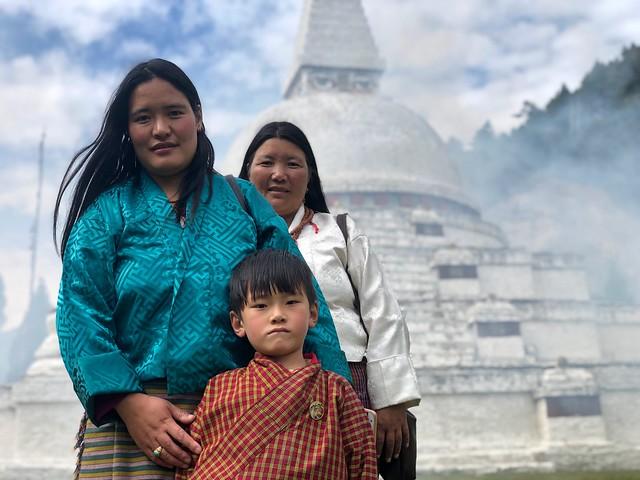
- One comes to Bhutan perhaps because of the pictures of the Tiger's Nest. But you end up staying with the courage, kindness and friendliness of the people. The locals are always smiling and polite to those who pay them a visit. They are very appreciative that you have chosen their small, isolated mountain kingdom to spend a few days. And they are aware that the foreign tourist makes a great effort to be there.
- There is not the feeling in other countries that the tourist is like a walking dollar. It is virtually impossible for someone to pester you to go into their shop or buy something from them. Let alone being asked for money. On the contrary, the Bhutanese are extremely shy and often do not address visitors out of purely idiomatic fears. You feel very welcome in this destination where the people are by far your best guarantee.
Shopping in Bhutan - is it expensive or cheap, and where is the best place to shop?
- Bhutan is not a country where souvenir shops abound. Craft shops are most common in Paro, though they can be found in all major towns. They sell many objects involved in Buddhist life (prayer wheels, bells, Tibetan bowls, etc.), but probably the most striking are the wooden masks that the monks use in the tsechus and the tangkas, paintings of the Buddha's life or mantras (also with the wheel of life), painted in extraordinary detail. In fact, some tangkas take months to complete.
- Even so, the handicrafts on sale in Bhutan do not differ much from those you can buy in countries like Nepal or Tibet. The difference is that the prices in Bhutan are much higher. Masks that would cost €40 in Nepal can cost five times as much in Bhutan (and if they are more elaborate, their value can be multiplied), so it makes sense to shop around a lot to find something good at a decent price. In short, Bhutan is not a country for shopping and, unless you really like something, you should think again. Or wait for Nepal or India, if you're coming from one of these destinations, where there are equally interesting things at a much lower cost to shoppers.
- Bargaining in Bhutan is not, shall we say, excessive compared to neighbouring countries. Sometimes you can get discounts of 5% or 10% (if you are very lucky 15%), but no more. And when they tell you the price of something you think they are multiplying its value several times over and that they will be willing to give you a discount. But they are not. And no matter how hard you push, they are not going to come looking for you with a calculator in their hand. This is not Nepal, India, Tibet or Morocco. If you're not convinced by the price, you'd better look elsewhere.
- There are more shops in Paro than anywhere else in Bhutan, so since there's more variety and, above all, more competition than in other Bhutanese cities, it's a good idea to wait here (you're usually here the day before you fly out) to pick up some souvenirs to take home. There are better prices and more bargaining opportunities, as far as possible. The Thimphu Handicraft School also has a small shop with some really interesting items at really reasonable prices.
Just in case, travel safe and insured...
- The Ministry of Foreign Affairs and Cooperation states on its website that in Bhutan "local medical services are limited. Basic emergency care is possible. For complex surgical interventions it is advisable to leave the country. It is therefore recommended that travellers take out a comprehensive medical policy that covers repatriation in case of accident or air rescue in case of mountain activities".
- Whenever we travel abroad, it is always a good idea to be fully covered for what might happen, which is why I never travel anywhere without the appropriate travel insurance. I would never advise a trip of this type without a good policy that covers us in Bhutan against possible accidents, illnesses (if we are affected by altitude sickness) or mishaps that could mean an unaffordable extra cost. In my case to travel to Bhutan (as well as Nepal, the link) I used IATI Estrella Insurance. It has a higher than average coverage (100,000 euros), they advance you the money if a problem occurs and they offer a personalised service. Readers of this blog can take out the IATI travel insurance that best suits what they are looking for with a 5% discount (applied directly through this link).
- Bhutan is an extremely safe country to travel to. Crime and delinquency rates are ridiculous and political stability is exemplary.
Connecting to the internet in Bhutan: How is the wifi and how easy is it to get a mobile data card?
- Bhutan, while not Japan or South Korea in terms of internet, has pleasantly surprised me when it comes to finding wifi in many places. Of course it works better in hotels in major cities (the Paro-Thimphu-Punakha axis does not fail) than in rural areas (but that in Bhutan and also in Spain). Duringeach and every day of our trip to Bhutan there was not a day when we did not have internet connection. Although it is true that it did not always work the same way.
- Fortunately, it is possible, easy and affordable to have data to connect to the internet in Bhutan via mobile phone during the whole trip. In any locality there are establishments that offer prepaid cards from the companies Tashi Cell or Bhutan Telecom (public), which, although they usually come with enough gigabytes, can be recharged. Prices range from 4 to 10 euros, depending on the plan chosen.
Is Bhutan an ideal destination for people who love photography?
- Mountainous landscapes on the edge of the Himalayas, Buddhist temples and monasteries overlooking the abyss, superlative dzongs dominating the great valleys, vast rice fields, stupas bathed in the smoke of a permanent incense... How can it not be a TOP destination for photography? Of course it is! However, I can assure you that the scenery and monuments are nothing compared to the immense possibilities for photographing people. It is rare to find someone who, with prior permission, refuses a photo or even a portrait. It is they, the people, who give humanity and authenticity to this destination in which all the space on the memory card and all the batteries are too few to be able to capture everything one would wish for.
And everything helps. The "scenery" that you find everywhere, the good disposition of the people and the enthusiasm they feel when they see themselves on the screen of your camera. The only "but" is that you are not allowed to photograph the interiors of religious monuments and temples. But perhaps there are treasures that should only deserve to be found in a cold digital photo album.
Bhutan or Tibet?
- It's funny but a good part of the questions I received even before embarking on the ten-day trip to Bhutan had to do with whether this destination is very similar to Tibet or which experience is better if I could only choose one. And all because the two overlap in religion and architectural concepts. But nothing more. The experiences provided by one destination or the other are completely different. Even the sensations. Here are some considerations regarding both, which I will end with a final conclusion:
The landscapes are absolutely nothing alike. Tibet is in the north of the Himalayas and Bhutan in the south. A short distance on a map but geographically and climatologically speaking a world apart. While Bhutan is green, lush and very fertile in much of its territory, Tibet has much more arid and dry landscapes typical of a very high plateau where it doesn't rain much (the Himalayas are a barrier to the clouds that rain abundantly in Bhutan). Both are exceptional panoramas, but they have nothing to do with each other.
Typical landscape of TibetTypical landscape of Bhutan
Tibet and Bhutan have in common that it is not possible to travel freely in their territories. And an agency is necessary. Tibet does not require $250 a day from its visitors but is more punctilious about permits (it is a somewhat more cumbersome process). Because of its peculiar and difficult political situation, with China on its neck, there may be border closures or foreigners may be denied access for a variety of reasons. In Bhutan, although you travel with a guide, driver and arranged transport, there is a total sense of freedom and a more relaxed atmosphere.
Tibet's Buddhist tradition predates Bhutan's and its temples and sacred sites are often over a thousand years old. In Bhutan, with the exception of a few temples erected by the Tibetan emperor Songtsen Gampo in the 6th century AD, most of the religious buildings you visit date from the 17th century onwards.
Religious roots are strong in both nations, but in Tibet it is perhaps more impressive to see the extreme devotion of the Tibetan people. There are great pilgrimages and they do some really exciting koras (clockwise circles of religious sites).
There is better Tibetan architecture in Bhutan than in Tibet, especially in terms of dzongs. It has preserved its style and tradition better. But Tibet has the best dzong of all, the mythical Potala Palace in Lhasa.
The delicate political situation since China's invasion of Tibet and the departure of the Dalai Lama in 1959 has made a truly reactionary and worrying process with the native inhabitants of the region very visible. The Chinese are building skyscrapers and cities that have nothing to do with Tibet where there was nothing before. There are numerous controls and the harmony of one of the oldest kingdoms on earth has been polluted. Bhutan, on the other hand, has a stable, established democracy and there is no sense of tension in the air.
A trip to Tibet brings you closer to the Himalayas, including the possibility of an overnight stay at Everest's North Base Camp. You are always at an altitude ranging from 3500 to 5200 metres, so the possible effects are greater than in Bhutan.
Both Tibetans and Bhutanese are wonderful people who hold on to their history and tradition. They are exemplary and always kind to visiting citizens.
My conclusion is that the two nations have nothing to do with each other except for certain religious, architectural and artistic concepts, as well as the good fortune of sharing the highest mountains on earth and a great sense of belonging to a place.
Information for the disabled
- Facilities for the disabled in Bhutan are virtually non-existent, both in towns, villages and, of course, natural environments. There is hardly any access (either in hotels or monuments) for people who need wheelchairs. Braille is conspicuous by its absence in hotels, establishments and monuments, so those with a visual impairment may find it a destination that is still not too easy. Nor, of course, for travellers with any kind of physical disability.
Potpourri of travel tips for Bhutan
- In Bhutan there are various types of plugs, but all hotels (regardless of category) allow round-plug sockets, as in Europe. The voltage is the same as in Spain, so no adapters are needed.
- The Bhutanese are not too bad at English (compared to China or Tibet there is a big improvement). It is a language studied in schools and the younger ones, who also like to watch TV series and films on cable TV in their original version, are starting to speak Shakespeare's language better and better. English is generally spoken by guides and some drivers, as well as workers in the tourist industry. On the other hand, in 2019 there were only four Bhutanese guides who spoke Spanish (ours was one of them), which is a great advantage for understanding many things and being able to communicate with the local population.
- It never hurts to make an effort to learn a few words in the native language. It sounds silly but the locals are very enthusiastic about it. Dzongkha is the main language spoken in Bhutan, although it is shared with many other languages and dialects. Hello is pronounced Ku zuk zang po la, while Gaday bay zhui is pronounced How are you? Ka drin che la is used to say thank you and for bargaining time when shopping, a Gadem chi mo? (How much is that?) and a Gong phab nang? (Could you give me a discount?) are sure to work well for a discount.
- Travelling to Bhutan with a basic understanding of the Buddhist religion (and if it's Tibetan Buddhism, all the better) will help you to understand many of the things that go on around you, especially in temples and monasteries. For those who have no idea of the concepts that govern this religion (and philosophy), there is a really easy-to-understand book by Gabriel Shaw entitled "Buddhism for Beginners: A guide to Buddhist teachings, meditation, mindfulness and inner peace" where he reviews the particularities of what in Bhutan, Tibet and other Asian countries is not just a belief but a way of behaving and assuming life. Tibetan Buddhism is also practised not only in Tibet and Bhutan, but also in northern India, Mongolia, Nepal and parts of Russia (such as Buratia, Kalmukia and Tuva).
So much for this list of travel tips for Bhutan, which I hope to update in the near future. New recommendations are welcome, of course.